ISTQB Certifications
International Software Testing Qualifications Board (ISTQB)
Certifications for testing and quality management
Practical and solid knowledge of quality management in the IT sector has become an important building block for a career in IT. That is why we offer you a comprehensive portfolio of training courses and certifications. This allows you to prove your acquired qualifications according to recognized standards. If you have any questions about choosing the right training program for you, the Spirit in Projects team will be happy to advise you!
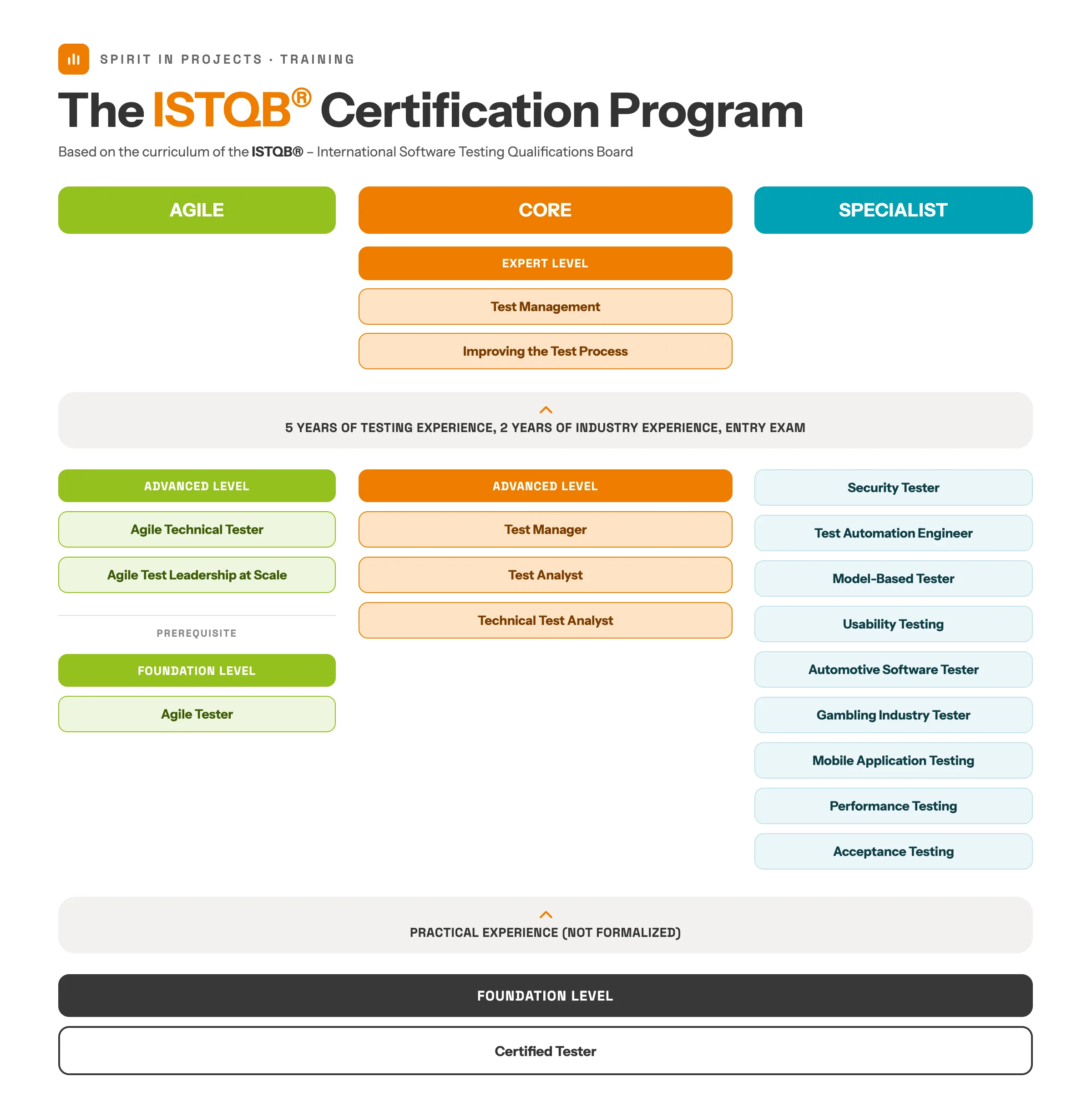
The ISTQB® scheme is the most clearly staged certification path in this portfolio: one fundamentals certificate, then the deep dive by task and the specialization by domain or technology.
1. Foundation Level
The Certified Tester Foundation Level is the entry point: terminology, test process, test design techniques. It requires no certification and is the basis for the entire Advanced Level.
2. Advanced-Level
At Advanced Level the work splits up: Test Manager (CTAL-TM) for planning and control, Test Analyst (CTAL-TA) for functional test design, Technical Test Analyst (CTAL-TTA) for the technical side. Each module leads to its own certification.
3. Specialize by domain and technology
Agile Tester and Automotive Software Tester sit at Foundation Level, test automation (CTAL-TAE), mobile application testing and the testing of AI-based systems at Advanced Level.
target group
The ISTQB certification is relevant for anyone involved in ensuring software quality throughout the development process.
Software Testers and Test Analysts: The classic core audience. They gain structured knowledge of test techniques, test design, and test management, providing proof of their expertise according to an internationally recognized standard.
Test Managers and Team Leads: Responsible for planning, steering, and taking ownership of test activities. The Advanced Level "Test Manager" module is particularly relevant for them.
Software Developers: Understanding testing principles helps them write more robust, more testable code from the outset and improve collaboration with the test team.
Business Analysts and Requirements Engineers: They work at the intersection of requirements and quality assurance and learn how to translate requirements cleanly into verifiable test cases – a valuable complement to an IREB certification.
Project and Quality Managers: They need to be able to contextualize, budget, and assess the quality of test activities within a project, even without testing operationally themselves.
Career Starters and Career Changers in IT Quality Assurance: For them, the Foundation Level offers a practical, prerequisite-free entry point into the testing discipline.
This makes the certification relevant both for those taking their first step into a testing career and for experienced professionals looking to deepen their knowledge and make their expertise visible.
Why should you obtain ISTQB® test certification?
Certification in software testing according to ISTQB® (International Software Testing Qualifications Board) standards is an important addition to the skill set of professionals in the IT industry. This is especially true for those working in software development and software testing. Here are a few reasons why someone in IT might consider ISTQB® certification and how it could benefit their career:
- Recognition and credibility: ISTQB® certification serves as proof of a person’s expertise and skills in the field of software testing. Employers view such certification as a sign of competence and commitment in this specific area.
- Expansion of expertise: ISTQB® certification provides structured training in various aspects of software testing, including testing processes, test management, testing tools, and test design. This expands the individual’s expertise and enables them to work more effectively and efficiently.
- Career development: ISTQB® certification can improve career opportunities by providing professionals with additional qualifications and expertise. This can lead to higher positions in companies, more responsibility, and potentially higher salaries.
- International recognition: ISTQB® certification is internationally recognized and valued by many companies worldwide. This means that professionals with this certification have the opportunity to work in different countries and for multinational companies.
- Compliance with industry standards: Many companies value compliance with industry standards to ensure the quality of their software products. ISTQB® certification demonstrates that the professional is familiar with internationally recognized standards in software testing and can implement them in their work.
Certification is an important building block for a successful career in IT. A certificate in software testing and quality management should be combined with practical experience and continuous professional development.